ASTROPHOTOGRAPHY • NEW MEXICO • ANNULAR SOLAR ECLIPSE
Chasing the Ring of Fire
A photographic journey to New Mexico for the October 14, 2023 annular solar eclipse — and an unexpected connection with Shiprock.
A Dream That Had Been Waiting for Years
Photographing an annular solar eclipse had been near the top of my bucket list for years.
I had seen photographs of the famous Ring of Fire, but seeing one in photographs and actually standing beneath one with my own camera are two very different things.
I wanted to experience it myself.
More than that, I wanted to photograph the entire journey of the Moon across the Sun—from the first partial phase, through the Ring of Fire, and all the way to the end.
The reason an annular eclipse happens is actually quite simple.
The Moon does not remain exactly the same distance from Earth throughout its orbit. Sometimes it is closer to us, and sometimes it is farther away.
When the Moon passes directly in front of the Sun while it is farther from Earth, it can appear slightly smaller than the Sun in our sky.
Because of that, it may not completely cover the Sun.
At perfect alignment, a brilliant circle of sunlight remains visible around the dark Moon.
That is the Ring of Fire.
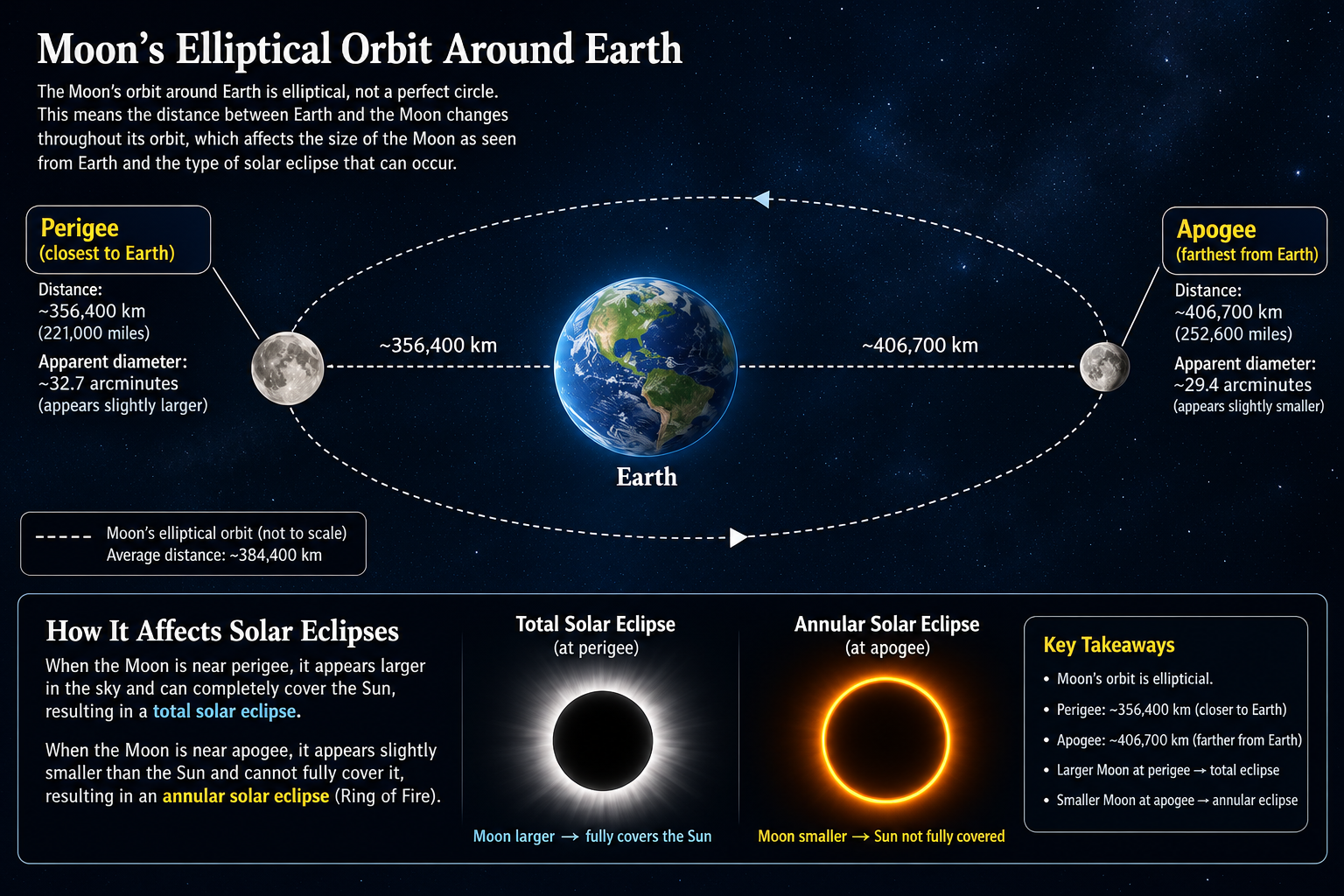
WHY THE MOON'S DISTANCE MATTERS
The Moon's orbit around Earth is slightly elliptical. Its changing distance changes its apparent size in our sky. When the Moon appears slightly smaller than the Sun during the right alignment, sunlight remains visible around it as the Ring of Fire.
View graphic at full size ↗Being in the Right Place
But knowing when an eclipse will happen is only half the challenge.
For an annular eclipse, you also have to be in exactly the right place.
The path of annularity is extraordinarily narrow.
On October 14, 2023, that path stretched like a slender ribbon across parts of North America, Central America and South America.
Only locations inside that path would experience the complete Ring of Fire.
Move far enough outside that narrow path, and the same event would appear only as a partial solar eclipse.
That made choosing my location one of the most important parts of the entire journey.
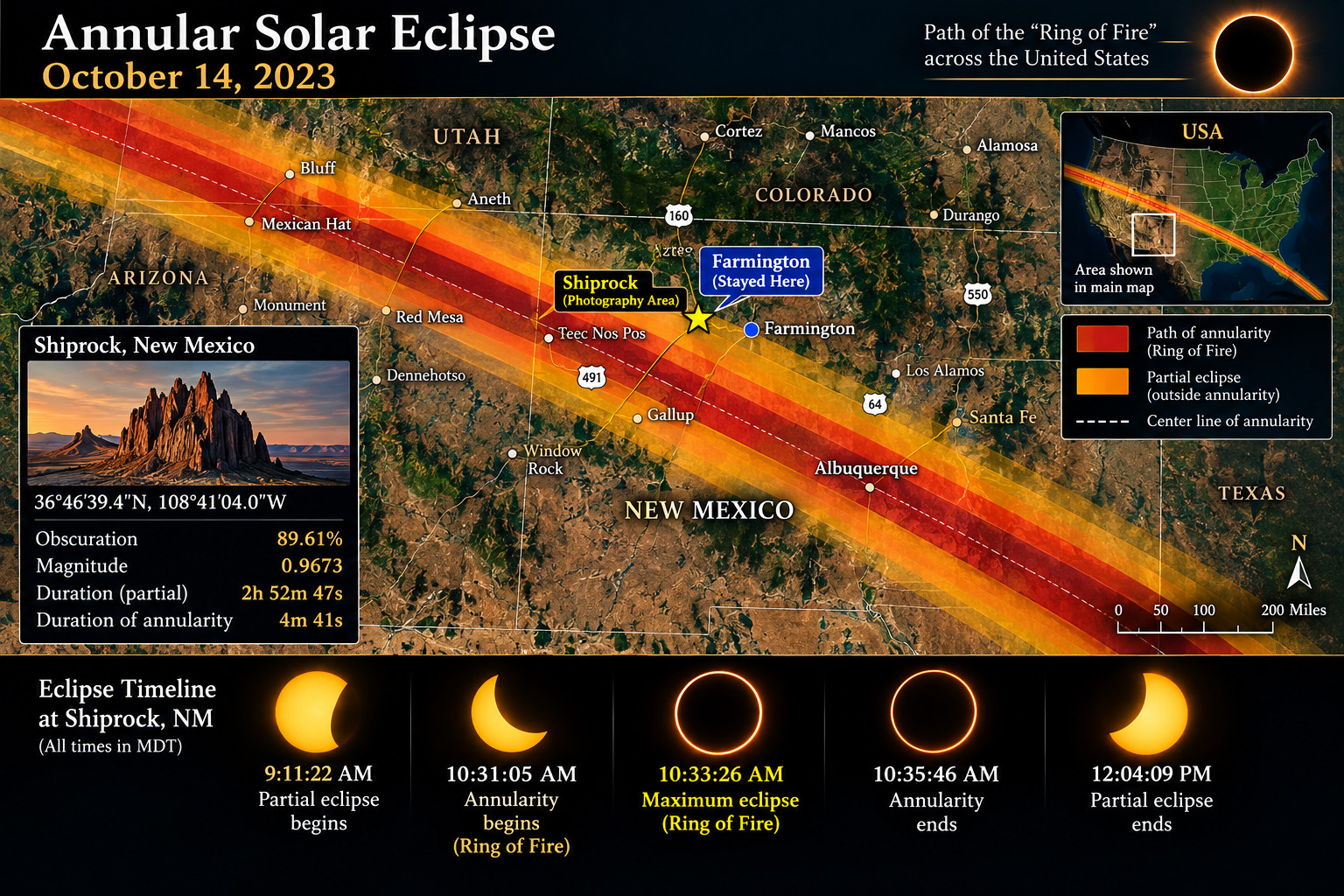
THE PATH TO THE RING OF FIRE
The October 14, 2023 annular solar eclipse path across New Mexico, including the Farmington and Shiprock area.
View graphic at full size ↗Months of Planning for Four Minutes
I had been thinking about this eclipse for a long time.
Once I knew the path would cross the United States, the idea became real:
I could actually go and photograph it.
Then the planning started.
I spent months researching the eclipse path, possible viewing locations, weather, roads and backup locations.
I didn't want to depend on a single spot.
If clouds appeared in one area on eclipse morning, I wanted another location somewhere along the path that I could drive toward while remaining inside the zone of annularity.
And then there was the photography equipment.
Cameras. Backup camera. Tripod. Solar filters. Lenses. Memory cards. Chargers. Batteries. And more backup batteries.
For an event that had been on my bucket list for years, forgetting one small but critical piece of equipment could ruin the entire experience.
I didn't just want to see the eclipse. I wanted to chase it.
Cleveland to New Mexico
The journey began thousands of miles away in Cleveland.
I flew from Cleveland to Phoenix, picked up my rental car, and began the long drive toward northwestern New Mexico.
I had booked my stay in Farmington, giving me a good base close to the path of annularity.
But even after reaching Farmington, I still hadn't completely decided where I would set up my camera.
Technically, there were many places where I could have stopped inside the path.
But I wasn't familiar with the area.
After waiting so long for this eclipse, I didn't want to randomly pull over somewhere on the morning of an event I had spent months preparing for.
So even after reaching my hotel tired from the journey, I continued researching.
Maps. Roads. Locations. Distances.
And somewhere during that search, Shiprock appeared.
At that point, I didn't really understand the significance of Shiprock.
I certainly didn't know how much that place would stay in my mind after this journey.
It simply looked like an interesting area near the eclipse path.
So I decided:
That's where I'm going tomorrow morning.
Before Sunrise
I woke up around 4:30 or 5:00 in the morning.
I was tired.
I hadn't managed to organize everything properly the previous night, so before leaving I went through my equipment again.
Camera. Tripod. Solar filters. Batteries. Backup batteries. Everything I could think of.
I had waited too long for this morning to discover at the last moment that something important was sitting back in the hotel.
Then, while it was still dark, I started driving toward the Shiprock area.
The partial eclipse wasn't scheduled to begin until after 9:00 AM.
I arrived before sunrise.
I was that excited.
After years of thinking about this moment, I simply didn't want to miss a single beat.
The Eclipse, Frame by Frame
As morning arrived, the quiet roadside slowly began changing.
More people started appearing.
Photographers and eclipse chasers began setting up around the area.
What had initially felt almost empty gradually turned into a gathering of people who had all traveled there for the same reason.
Then, at 9:11:22 AM MDT, it began.
October 14, 2023 · All times MDT
The Eclipse Timeline
- Partial begins
- Annularity begins
- Maximum
- Annularity ends
- Partial ends
I had arrived before sunrise, and I stayed to photograph the entire event.
Slowly, frame by frame, the Moon began moving across the Sun.
ASTRONOMICAL SEQUENCE
The Eclipse, Frame by Frame
Twenty moments from first contact to the Ring of Fire and back again.
The Ring of Fire
At 10:31:05 AM, annularity began.
The remaining crescent of sunlight closed around the Moon until, finally, there it was.
A complete circle.
At 10:33:26 AM, the eclipse reached maximum annularity.
Through my solar-filtered camera, I could see the dark disk of the Moon surrounded by that brilliant ring of sunlight.
The Ring of Fire.
For months I had looked at maps, checked locations, planned backup locations, packed equipment and imagined what this moment might look like.
Now it was actually happening in front of me.
Annularity lasted only a few minutes.
At 10:35:46 AM, the ring began opening again as the Moon continued its journey.
But I didn't pack up.
I kept photographing.
The Moon slowly moved farther away from the center of the Sun until, at 12:04:09 PM, the partial eclipse finally ended.
From before sunrise until the final phase, I had stayed there to photograph the entire event.
The bucket-list photograph was finally mine.
The Ring of Fire
October 14, 2023 — New Mexico
A Stranger Beside Me
During the morning, I also started talking with another eclipse watcher nearby.
He was a pilot from the nearby airport and had come out to experience and photograph the eclipse too.
Then he realized something every photographer fears.
He had forgotten his camera battery.
I knew that feeling immediately.
I checked whether one of my batteries might work with his camera, but unfortunately it didn't fit.
I felt bad because he had come there for the same extraordinary event.
He asked me to share some of my pictures with him so he could at least see what I had captured.
It was a small interaction, but somehow it became part of my memory of that morning—the excitement, strangers talking to one another, photographers comparing equipment, and everyone looking toward the same Sun.
The eclipse eventually ended.
I had accomplished what I had come to New Mexico to do.
At least, that's what I thought.
Because something else had quietly entered the story.
CHAPTER TWO
THE LAND BEYOND THE ECLIPSE
Then There Was Shiprock
An unexpected presence on the New Mexico horizon.
I traveled there chasing something happening in the sky. Yet I found myself fascinated by something rising from the Earth.
During the eclipse morning, Shiprock had been part of the landscape around me.
But at the time, I really didn't know much about it.
After the eclipse, I started researching the place I had been seeing.
That's when I began learning about Shiprock—Tsé Bitʼaʼí—and its significance to the Diné (Navajo) people.
And suddenly I wanted to see it again.
So later that evening, I drove back toward Shiprock.
This time, I wasn't chasing an eclipse.
I was going there simply because something about that landscape had stayed with me.
I knew I needed to respect the restrictions around the formation, so my experience remained from appropriate roadside viewpoints rather than trying to approach or climb it.
And honestly, distance didn't diminish it.
Seeing Shiprock rise alone from that enormous landscape was enough.
There was something peaceful about the place that I found difficult to explain.
After spending so much time preparing for an event in the sky, I had unexpectedly become fascinated by something rooted firmly to the Earth.
It felt as though Shiprock didn't want me to leave.
One Last Look
The next morning, it was time to leave.
I needed to drive south and eventually make my way back toward Phoenix.
I wasn't planning another Shiprock visit. It would take me away from the direction I needed to travel.
So I started driving.
And then, far in the distance, I saw it again.
Shiprock.
I kept driving.
And it remained visible.
For more than half an hour, every so often I could look across the enormous open landscape and still see that unmistakable shape sitting on the horizon.
Smaller and smaller.
But still there.
It gave me a strange feeling—as though this place I had discovered almost accidentally wasn't quite finished with me yet.
I had traveled to New Mexico with one very specific goal:
Photograph the Ring of Fire.
I accomplished it.
But when I think about that journey now, I don't remember only those four minutes of annularity.
I remember waking before sunrise. The empty roads. Setting up the tripod. Watching other eclipse chasers arrive. The pilot beside me who forgot his battery. The first bite of the Moon against the Sun. The Ring of Fire. And then Shiprock.
I went for the sky.
I came back remembering the land.
Astrophotography often begins by looking upward.
We chase darkness, clear skies, celestial alignments and photons that may have traveled extraordinary distances before reaching our cameras.
But sometimes the journey toward the sky introduces us to something completely unexpected here on Earth.
For me, this was one of those journeys.
And one day—eclipse or no eclipse—
I know I will return to Shiprock.
Sabyasachi Dash
ChasingDPhoton